Sales roleplay · Pilot in preparation
Smart Training
Practice the difficult sales conversation before the real one.
Turn a difficult buyer objection into a practice attempt, a specific coaching discussion, and a better question to test.
Public access is not open. This is a conversation request, not registration or a waiting list.
Inside the product
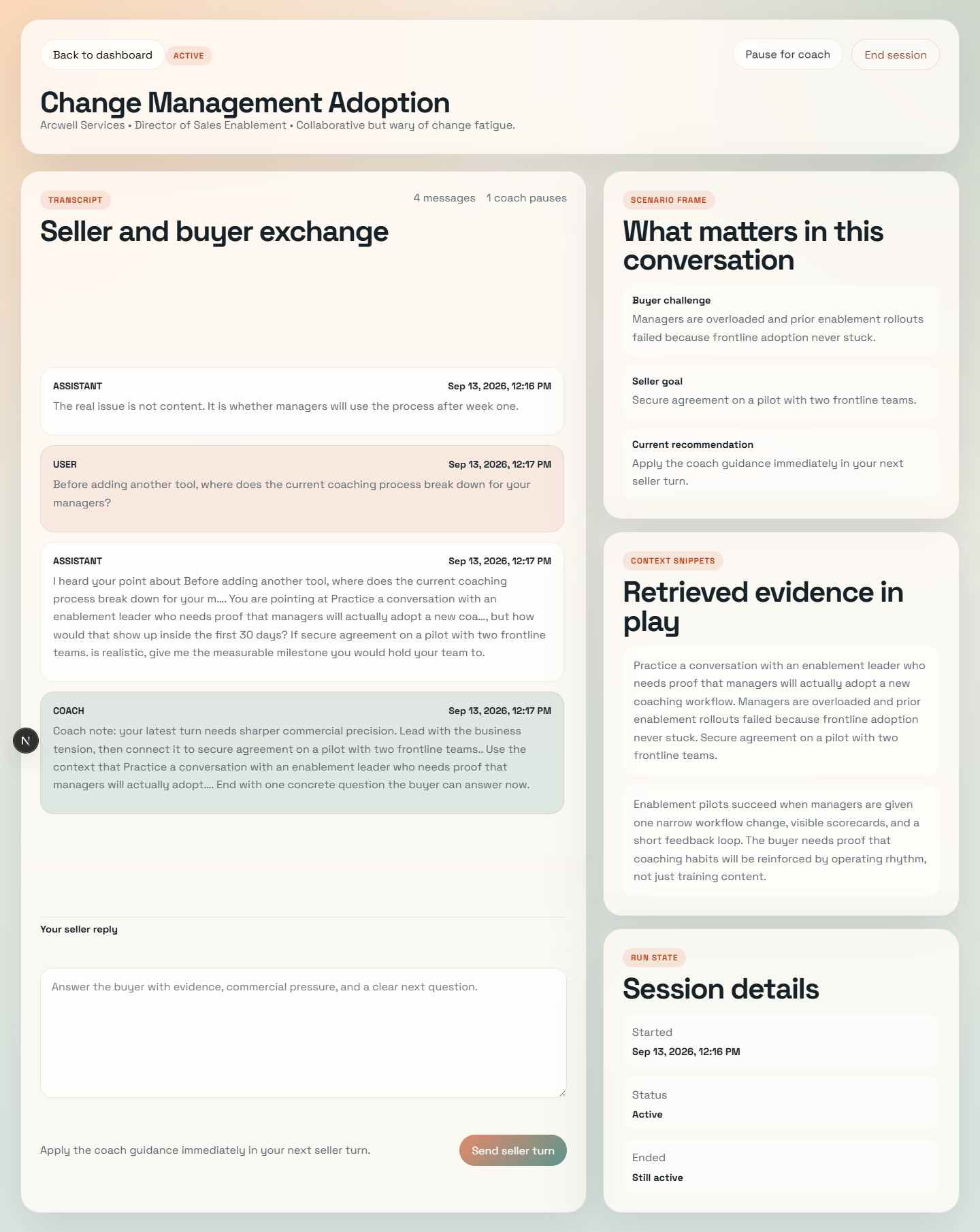
A conversation you can pause and review.
Local product example
Synthetic practice data
The moment worth practising
The buyer knows your features. What changes their decision?
“We already train our salespeople. Why would we need another tool?”
A completion record shows who attended. A practice conversation lets you inspect what someone says when the value is challenged.
Illustrative responses written for this example, not live AI, a skill assessment, or customer results.
Lead with more features
“We have roleplay, coaching prompts, and saved transcripts.”
Possible buyer response: “But we already have training content. What problem would this solve?”
Review: The features are real, but the reason to change is still missing. Establish the gap before describing the tool.
Push for urgency
“Your competitors are investing in this. You cannot afford to wait.”
Possible buyer response: “What evidence do you have that this is urgent for us?”
Review: Pressure is not a commercial insight. Do not invent competitive evidence or a deadline.
Test a useful distinction
“Completion tells you who attended. How do you currently check what a seller says when a buyer challenges the value?”
Possible buyer response: “Managers listen occasionally, but we do not have a consistent rehearsal process.”
Review: This opens a question worth exploring. If their current process works well, another tool may not be needed.
One practice loop
Choose. Rehearse. Reflect.
Choose a scenario
Start with a buyer role and a commercial situation from the scenario library.
Work through the objection
Write a seller reply, read the buyer response, and pause for coach guidance when needed.
Review the transcript
End the session and reopen the saved exchange from the dashboard for reflection.
First-pilot scope
Focused on text practice.
For salespeople, frontline managers, and enablement teams exploring a structured rehearsal workflow.
- Account sign-in and an organization-scoped workspace.
- Buyer scenarios and rule-based text replies.
- On-demand coach guidance during practice.
- Saved transcript history and account deletion.
Example situations
- Change Management Adoption
- Discuss a training rollout with a sales enablement buyer.
- Frontline Coaching Consistency
- Practice a conversation about coaching differences across managers.
- Forecast Confidence Through Coaching
- Explore a RevOps buyer's concerns about conversation quality.
These are practice scenarios, not evidence of customer outcomes. Pilot terms and pricing have not been announced.
Evidence, with boundaries
A reason to test the approach. Not a promise of more sales.
Practice a behaviour
A review of 117 behaviour-modelling studies found stronger effects on learning than on business results. Application needs its own evaluation.
Taylor, Russ-Eft & Chan, 2005Adapt to the buyer
A meta-analysis of 155 sales samples linked adaptive selling with performance measures. It did not test this app or establish an app-driven uplift.
Franke & Park, 2006Debrief the attempt
A meta-analysis of 46 samples supports structured debriefing across varied settings. An on-demand software prompt is not automatically an equivalent intervention.
Tannenbaum & Cerasoli, 2013
These studies did not evaluate Smart Training. Its effect on learning, workplace behaviour, and revenue remains unverified. Human review is part of the proposed evaluation, not an automatic team-reporting feature.
A small decision before a larger commitment
One conversation. Four rounds. A stop/go review.
A possible two-week evaluation for a small team: agree one behaviour, rehearse it, and decide whether the workflow earns a place in your coaching routine. Scope, facilitation, access, and commercial terms must be agreed first.
- BaselineAn uncoached attempt.
- First revisionOne specific review note.
- Buyer variationA different role or concern.
- Final checkAn unfamiliar comparable case.
Agree what would justify continuing
- Willing participants and an accountable reviewer.
- Observable questions, buyer relevance, and a concrete next step.
- Acceptable practice and review time.
- A final decision, including the option to stop.
The reviewer uses agreed criteria outside the app. A small evaluation tests usefulness and feasibility, not causal revenue impact. No customer calls or confidential examples are needed.
Discuss an evaluation
Is there a conversation worth testing?
Bring one buyer role and a recurring objection. We can inspect the current workflow, agree what useful evidence would look like, and decide whether a small evaluation is appropriate.
Best fit: a team with a specific practice need and a willing human reviewer. Not a fit for a requirement for live voice, automatic certification, or a guaranteed sales uplift.
Discuss Smart TrainingBefore pilot access opens
Hosted testing, support contact, and recovery checks still need to be completed. Any access invitation will follow those checks.
The planned app policy retains completed or abandoned transcripts for up to 30 days by default; active sessions are not pruned until they end. Account deletion removes the account and its history immediately.
Product accounts and transcripts belong to the separate application. Enquiries through this website follow its Privacy & Data Notice. Please use a fictional example and leave customer information out of your enquiry.
Commercial Practice Notes
Practical questions and exercises for better commercial decisions, with research you can inspect.
Explore the newsletter